

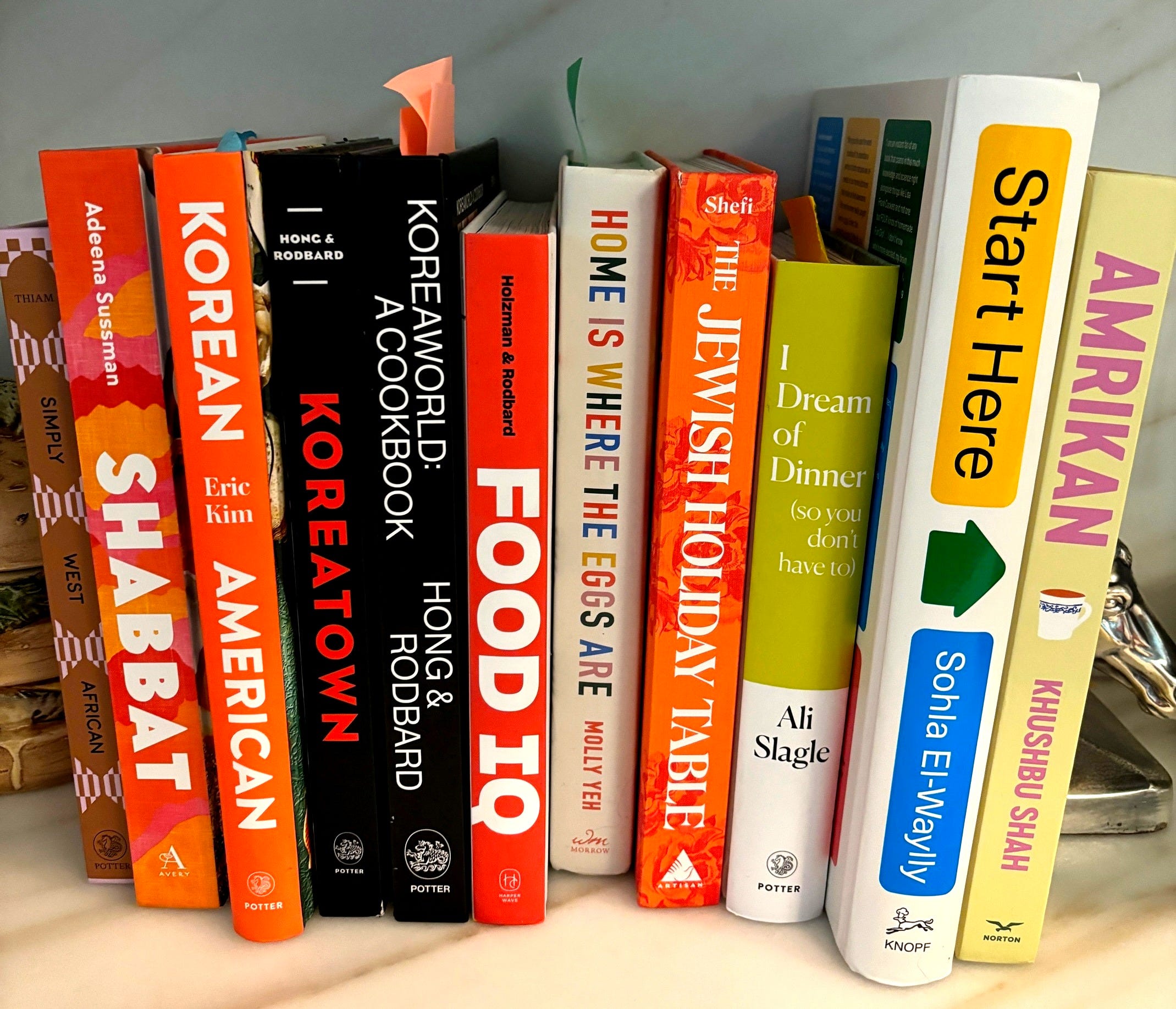
This summer, I’ve been in the thick of a cookbook-adjacent project for TASTE. The “adjacent” part is really fun, and I’m working on it with an extremely talented recipe developer. I’m keeping this vague because we’ll announce the project sometime next year. But being deep in a manuscript, particularly shaping recipe concepts and headnotes, I’ve been thinking a lot about credit: Crediting cultural origin. Crediting restaurants. Crediting other recipes.
The common refrain you hear when dipping into this topic is that “no recipe can be copyrighted.” Yes, it’s true, no recipe can be copyrighted. “A mere listing of ingredients is not protected under copyright law,” is the official word from the US government. The government guidelines continue. “Where a recipe or formula is accompanied by substantial literary expression in the form of an explanation or directions, or when there is a collection of recipes as in a cookbook, there may be a basis for copyright protection.”
It's still pretty gray, and an insufficient response to a complicated subject that is increasingly becoming a flash point in the recipe development arms race going down on your favorite Substack and social media platform.
There’s a universal assumption among many of the colleagues I speak with working in food writing that two things are happening with many (NOT all) recipe creators online:
1. There is no way for one person to possibly master (or at least pretend to master) the extremely wide variety of cuisines being presented by individual creators. The creator pivoting from cao lầu to kalbi to Bolognese to dal palak to meat-and-three-style mac and cheese to ceviche in a couple months’ time? Just, like, no way.
2. Recipes are being copied, widely and wholesale, with little consequence.
Last week, I was doubly reminded of this issue by the minor dustup between Jeni’s Ice Creams founder Jeni Britton and the New York Times. To summarize, NYT Cooking published a fun package for summer ice cream making, anchored by a recipe with a “secret ingredient” that makes the process easier. It’s a nice feature with some video and ace food styling. (Props to Barrett Washburne. Ice cream is tough.) The issue was that the secret ingredient—big reveal, it’s cream cheese—originated in Britton’s kitchen in 2007.
Jeni put out a very good response on Reels. First, the message was clear. She outlines how using cream cheese rather than the more traditional custard base to make high-quality ice cream at home is something she has long supported, and that she even wrote about it in her award-winning 2011 cookbook. Second, she was calm, and—while pointing fingers—the energy wasn’t bullying or going to the mat. She’s bummed, and it’s clear, but she ends by just saying, “Go make ice cream, have fun.” I really like that part. That’s kind of the point of all of this.
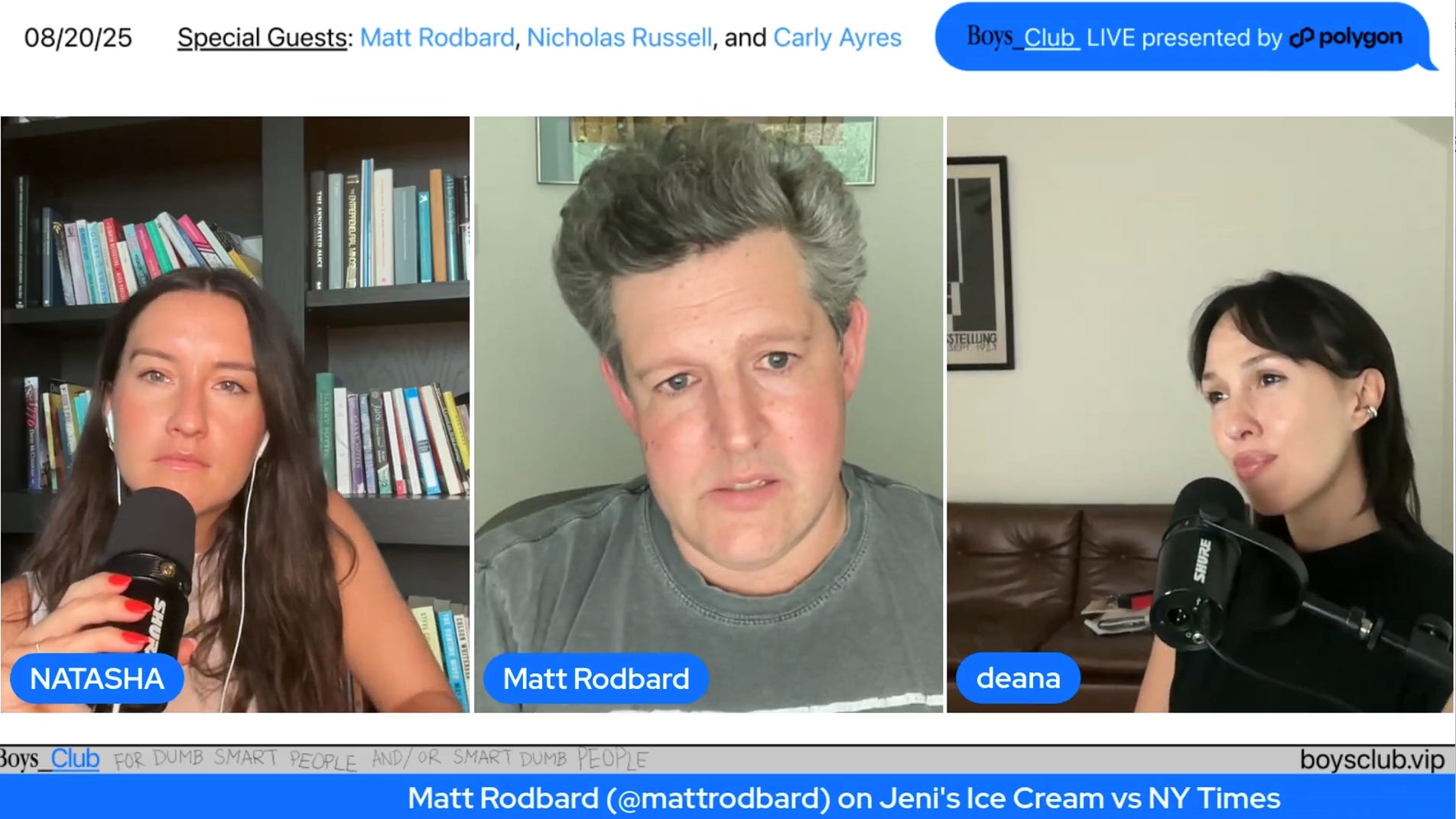
I was asked by the excellent Boys Club podcast to talk about the incident. (I also go on a little tangent about next-gen Las Vegas chefs on the episode.) My takeaway: This was not an instance of copying a recipe wholesale. Jeni Britton’s recipe calls for a smaller amount of cream cheese than the NYT’s does.
And while Jeni was an early advocate of using cream cheese in an ice cream base, it’s hard to say whether she was the absolute originator of the idea. My hunch is that somebody may have published this concept before her—one of those crusty spiral-bound community church/synagogue cookbooks probably has Philadelphia cream cheese creeping into the ice cream machine.
What’s more essential is the New York Times failing to credit the inspirations for the recipe. It’s clear that Jeni has a long record of using this “secret ingredient” well before 2025. A simple web search reveals this. What’s the harm in offering a short mention in the headnotes?
I’ll write it in here:
“This easy vanilla ice cream doesn’t contain egg yolks as a lot of ice cream recipes do. Instead, it relies on cream cheese to provide texture, stability and scoopability—a method popularized by Jeni’s Ice Creams founder Jeni Britton in her 2011 cookbook, Jeni’s Splendid Ice Creams at Home. The cream cheese adds a brightness to the finished ice cream and helps any flavor you add to it shine.”
Recipe writers have a responsibility to credit their inspiration. Crediting the culture of origin is the baseline of expectations—I don’t need to go on about that. But credit can also extend to a technique borrowed from a restaurant or a chef’s cookbook. If you don’t quite know what you are writing, do a little homework before hitting publish. That marriage of chocolate and passion fruit might not be yours (see: Pichet Ong’s run with Jean-Georges).
Khushbu Shah and I talked about this in our fun This Is TASTE episode earlier this week. Our conversation dipped into some of the above, but also into how it would be really cool if restaurant menus credited origin a little more. We’ve all seen that 20th Century Cafe honey cake out in the pastry-case wilds. A little credit would be nice to see.
Like with films, a list of credits on restaurant menus would be something worth reading for a great many diners. When done with a nice design flourish, the upside of crediting a book or past sous-chef on a menu so outweighs the downside of pissing somebody off by copying them. As the saying continues to go, you cannot copyright a recipe. But you sure can give one credit.
Love this! Speaking of restaurant menus crediting inspirations, I love how Funke does this with their pastas, crediting each shape to the nonna who taught them. It really creates a compelling story and narrative to the menu. So heartwarming
I was very surprised when I read the NYT ice cream story that there was no mention of Jenni Britton. I read the intro a couple of times thinking I might have missed it!